Blog // Technical Articles
What Are the Sills on a Window? Understanding the Anatomy and Function | Aluminium Cills Ireland
What Are the Sills on a Window? Understanding the Anatomy and Function
To the untrained eye, a window sill is just a ledge at the bottom of a window opening. However, in professional construction and architecture, the window sill (or cill) is a critical engineered component designed to protect the building envelope from water ingress and structural rot.
The primary function of a window sill is weatherproofing. It forms the horizontal base of the window reveal, deflecting rainwater away from the underlying masonry, insulation, and timber frame structure.
The Anatomy of an Engineered Window Sill
To understand how sills operate on modern Irish builds—particularly on insulated properties—you must understand their anatomy:
- The Upstand (Rear Flange): This is the vertical bend at the back of the sill (typically 25mm to 30mm high) that sits directly beneath the window frame's cill groove. It must be sealed with low-modulus neutral cure silicone (ISO 11600 Class 25LM) or cill tape to prevent wind-driven rain from passing under the window track into the cavity.
- The Reveal Offset (Sill Bed): This is the horizontal flat section of the sill. On standard cavity brickwork, this might be 150mm. On retrofit projects using External Wall Insulation (EWI) or Insulated Concrete Formwork (ICF) structures, the reveal depth can range from 250mm to over 500mm. The bed must have a slope (or fall) of at least 1:12 (approx. 5 degrees) to ensure water runs forward.
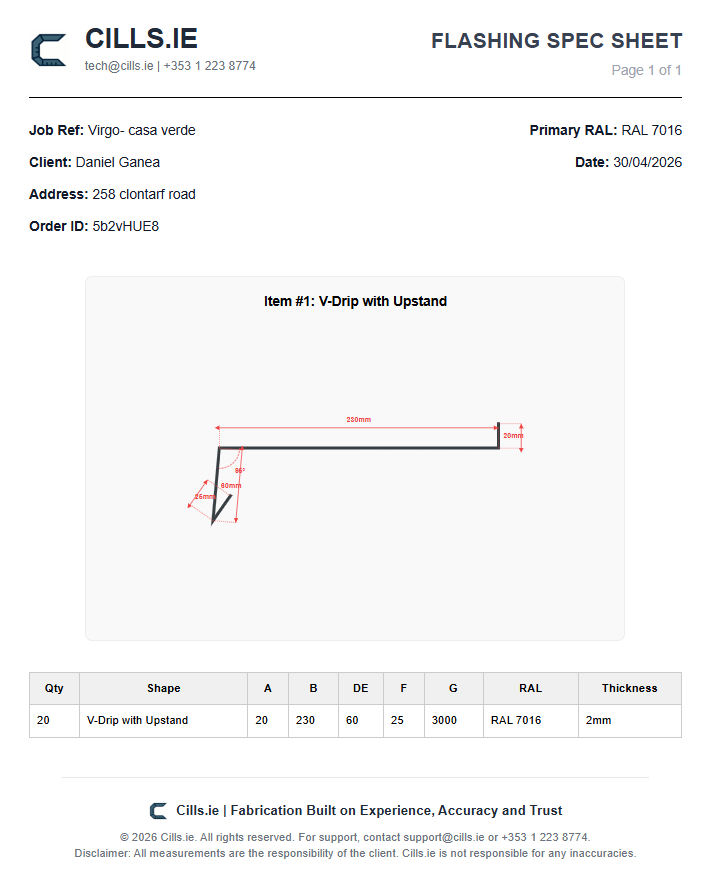
- The Drip Edge (Front Projection): The sill must project beyond the finished face of the outer wall (usually by a minimum of 40mm). The front edge is folded downwards to form a 40mm drop, with an inward return fold at the bottom. This breaks the surface tension of running water, causing it to drip clear of the render, preventing staining and frost damage.
- Stop-Ends (End Caps): These are the raised vertical tabs (minimum 20mm high) on the left and right sides of the sill. They prevent water from running off the ends of the sill into the plaster or insulation reveals, directing all water forward to the drip edge.
- Splice/Joiner Plates: Used for runs longer than 3-4 meters to accommodate thermal expansion (aluminium expands 2.3mm per meter for a 100°C temp range).
The Engineering Shift: Concrete to Thermally-Broken Aluminium
Traditional Irish construction relied heavily on heavy precast concrete sills. While durable, concrete acts as a massive thermal bridge, drawing heat out of the house. Today, 2mm marine-grade aluminium window cills are the professional standard. They allow for integrated thermal breaks, are lightweight, and can be custom-bent to suit any EWI insulation depth without structural modifications.
---
Get in Touch with Cills.ie
Need precision-engineered aluminium window sills with welded stop-ends and custom upstands? Configure and order your sills in 3D using [Cills.ie](https://cills.ie), download the CILLS App on iOS or Android, or contact our Dublin technical desk at +353 1 223 8774 / info@cills.ie.
// Direct Fabrication Supply
Configure & Order Online
Specify your window sills, cappings, or flashings with millimetre accuracy. Watch the 3D preview build in real time and submit your order directly to our CNC machines.
Author

Seán McCarthy, Principal Engineer
TECHNICAL CONTRIBUTOR
Navigation
Back to Blog
Explore more guides and insights on precision aluminium fabrication written by our specialists.
← All ArticlesCills.ie Partnership
Order on Cills.ie
Need window cills, cappings, or trims fabricated to your site dimensions? Configure in 3D and order on Cills.ie.
Start Measuring →// B2B Feedback
What Contractors Say
We work with leading residential developers, external wall insulation (EWI) installers, and commercial contractors across Ireland.
"Fabricator.ie and the Cills app have completely transformed our window sill specification. By scanning reveals and locking in 3D dimensions, we eliminated ordering errors entirely. Site measurement and fitting services are flawless."
"For retrofitted external insulation, reveal depths vary constantly. The ability to configure deep reveal aluminium cills (350mm+) with exact welded stop-ends and receive them in 3-5 days is a game changer for our schedules."
"We specify Fabricator.ie for our high-end residential and commercial projects. Their 2mm marine-grade alloy and Qualicoat powder coating finishes meet our strict specifications for coastal wind-load and salt-spray protection."
// Article FAQs
Frequently Asked Questions
Can I share or duplicate this technical guide?
Yes, our technical guides are free to share under standard attribution, designed to assist contractors, specifiers, and architects in Ireland.
How do I implement these aluminium specifications on my project?
You can download our CAD files or configure the dimensions directly on the Cills app to match the instructions in these guides.